Hydro JettingBuilt To Outlast A Snake
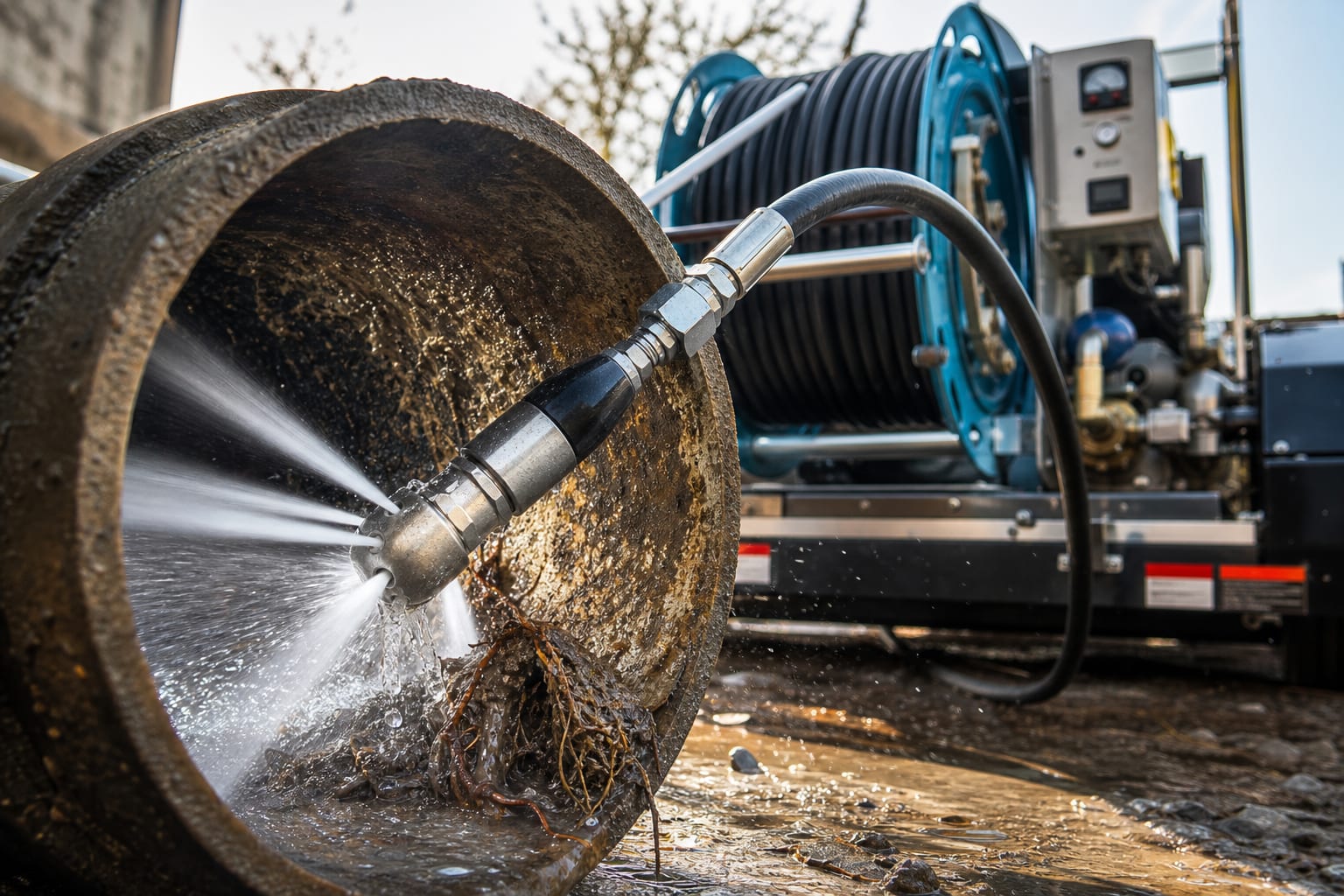
A cable machine bores a tunnel through the middle of a clog and calls it done. Grease, roots, and hardened scale stay stuck to the pipe wall and rebuild fast. Our truck-mounted jetter scours thefull inside diameter at up to 4000 PSI, and we run a camera through the line before and after so you see the pipe, not just our word for it.
Signs your drain needs jetting, not just cabling
Plenty of clogs are simple: a hair tangle, a wad of paper, one quick cable pass and you're done. But some drains keep backing up within days no matter how many times they get snaked, because the actual problem coats the pipe wall rather than sitting in the middle. If any of the six situations below sound familiar, jetting removes the buildup itself instead of just poking a new path through it.
Grease-Lined Kitchen Drains
Cooking oil and food fat coat the inside of a kitchen line and set into a hard shell over time. A cable just carves a channel through it. The rotating high-pressure spray of a jetter is what actually strips that coating off the pipe.
Roots Working Into Joints
Small roots find hairline gaps at pipe joints and grow into a thick web chasing moisture. Jetting cuts them back flush with the wall and pushes the debris out, giving you clear flow while we determine if the joint itself needs attention.
Hard-Water Scale Narrowing The Pipe
Mineral deposits from hard water and aging cast iron build up along the inside wall and shrink the usable diameter year after year. Jetting cuts through the crust and restores the pipe close to its original bore.
Commercial Lines That Back Up On A Schedule
If your restaurant, salon, or multi-unit building clogs like clockwork, a scheduled jetting visit keeps grease traps and branch lines open so you're not shutting down mid-shift to deal with an emergency.
Sediment Settled In The Main Line
Soap residue, sand, and years of small debris settle along the bottom of a main line and trap everything flowing behind it. A full jetting pass sweeps that layer of sediment downstream and out of the system entirely.
Same Drain, Same Call, Every Month
If a recurring drain clog keeps returning right after cabling, the buildup coating the walls is the real culprit. Jetting removes that source rather than briefly restoring flow through the center.
A quick fix versus an actual fix
A cable machine is fast, gentle, and often all that's needed for a single slow fixture, and we still reach for it when it's the right tool. A standarddrain cleaning visit handles most of those calls. But once grease, roots, or scale have coated the pipe wall, cabling only reopens the center and the blockage rebuilds fast. Hydro jetting is what actually cleans the pipe rather than just clearing a path through it. We check the line's condition with a camera first, jet it end to end, and camera it again so you can see the result for yourself.
Our jetting visit, step by step
Camera The Line Before Anything Else
We feed a camera through the pipe first to confirm it can safely handle high pressure and to see exactly what we're dealing with: grease, roots, or scale. We don't jet blind, and we don't skip this step to save time.
Stage The Jetter And Pick A Nozzle
The truck-mounted jetter runs a high-pressure hose in through the closest cleanout. Based on what the camera showed, we attach a root-cutting head, a grease nozzle, or a scale-cutting tip built for that specific blockage.
Scour The Entire Wall
Water at up to 4000 PSI blasts across the full inside surface of the pipe while rear-facing jets drive loosened debris downstream toward the main. It's a level of cleaning a cable simply cannot achieve.
Run The Camera Back Through
A second inspection pass shows a bare pipe wall on screen, real proof the line is clear and not just temporarily open down the middle. You see the same footage we're looking at, in real time.
Tell You What We Found, Plainly
If the after-footage shows a crack, sag, or separated joint, we walk you through sewer line repair options without pressuring you into anything. Every jetting job we complete comes with a written warranty.
Recommend A Maintenance Cadence
For busy kitchens and multi-unit properties, we suggest a jetting interval so grease and sediment never get the chance to rebuild into a backup. It costs far less than a mid-service emergency shutdown.
Nothing hidden, everything on screen
You shouldn't have to trust a verbal report. Our before footage shows exactly what's clogging your line, and the after footage shows a clean pipe wall so you can judge the result yourself. Here's what moves the number we quote you before the jetter ever turns on.
- Diameter of the pipeA narrow branch line jets in short order; a full sewer main takes longer and more capacity.
- What's causing the clogGrease, roots, and scale each call for a different nozzle and a different number of passes.
- How the line is accessedAn open cleanout is quick work; running a hose down a roof vent adds time and labor.
- Distance to the sewer tie-inHow far the line runs before it reaches the connection point affects total job time.
- Residential or commercialA home branch line is a different job than a grease-loaded restaurant main.
- Pipe condition on the cameraOlder, brittle cast iron sometimes found in South Florida homes changes how much pressure is safe.
One truck, three counties of coverage
Broward County
- Hollywood
- Fort Lauderdale
- Davie
- Pembroke Pines
- Plantation
- Pompano Beach
Miami-Dade County
- Miami
- Aventura
- Miramar
- North Miami Beach
- Hialeah
Palm Beach County
- Boca Raton
- Deerfield Beach
- Delray Beach
- Boynton Beach
- West Palm Beach
What clients see when we jet a line
"Our diner's kitchen line clogged constantly, twice a month at least. They jetted it and showed me the grease coating on the before video next to a clean pipe after. We're going on four months with no backup now."
"Our main had been snaked twice by another company and clogged again within a month both times. This team cameraed it first, found root intrusion, jetted it clear, and explained what to watch going forward. Finally felt like the problem got solved instead of postponed."
"Appreciated that they inspected before jetting instead of just firing away. Turned out my line had years of scale narrowing it down. Water drains immediately now, and the price was locked in before they started, no surprises after."
I manage a condo building and put them on a twice-yearly jetting schedule for our stack lines. Not one emergency backup since we started. The camera reports make it simple to justify the line item to the board.
Hydro Jetting FAQ
What's the real difference between jetting and snaking?
A cable snake is a mechanical tool. It bores or hooks its way through a blockage, restoring flow through the middle of the pipe while leaving grease, root residue, and mineral scale stuck to the walls. Hydro jetting sends water through a specialized nozzle at up to 4000 PSI that scours the entire inside surface, removing the buildup that causes the clog in the first place. One approach opens a channel; the other actually cleans the pipe. That's the reason jetted lines tend to stay clear far longer than lines that were only cabled.
Will jetting damage my pipes?
Not when it's approached correctly, which is exactly why we camera the line before we ever jet it. That inspection confirms the pipe is sound and lets us pick a pressure and nozzle suited to its age and material. Solid PVC, copper, and healthy cast iron all handle jetting fine. If the footage shows a pipe that's already cracked, badly corroded, or on the verge of collapse, we won't jet it. We'll show you exactly what we saw and talk throughcast iron replacement instead. Skipping the camera step is not something we do.
My restaurant keeps clogging. Is jetting worth the cost?
Commercial kitchens send a steady volume of fats and oils down the drain, and that residue hardens on the pipe wall in a way snaking never fully removes. A backup mid-shift costs you revenue and creates a health-code headache. Jetting on a set interval strips that grease off before it can build back up, which is why several restaurants and food-service properties we serve keep us on a scheduled maintenance plan rather than waiting for the next emergency call.
Does jetting get rid of tree roots for good?
A root-cutting nozzle on the jetter shears intruding roots back to the wall and flushes the material downstream, which restores flow immediately. What it doesn't fix is the crack or open joint that let the roots in to begin with, so regrowth is possible over time. After jetting, our camera pass shows us the entry point. If it's minor, we can set up a periodic jetting visit; if the damage is more serious, we'll walk you through trenchless sewer repair so the opening gets sealed permanently.
How long should I expect a jetting appointment to take?
A short residential branch line, including both camera passes, is often wrapped up within an hour or two. A long grease-loaded commercial main takes more time, and awkward access, like feeding the hose down a roof vent, extends it further. Once we've inspected the line and know what we're working with, we give you a real window rather than a guess. Since we never skip the verification steps, you get a thorough job rather than a rushed one. Call (954) 613-1060 and we'll talk you through what to expect.
Schedule Jetting
Stop treating the symptom. Clean the pipe.
If a drain keeps backing up no matter how many times it's been snaked, hydro jetting removes the actual buildup and the before-and-after footage proves it worked. Licensed and insured under Lic. #XXXXXXX, with a written warranty on every job across Broward, Miami-Dade, and Palm Beach.
Call (954) 613-1060