
Stop GuessingLocate The Leak First
A slab leak in a Hollywood home rarely shows itself until the bill or the baseboard already tells the story. We track it down withacoustic listening gear, electronic tracing, and thermal imaging so the opening we cut is as small as the problem, not as big as our guesswork.
Six ways a hidden leak shows up
Nothing changed at home but the invoice climbed sharply. A pinhole under the slab or a failing supply line drips around the clock, and the meter counts every gallon whether anyone's awake or not.
A tile patch that stays warm points toward a hot-water line leaking beneath it. Cool, damp spots, buckling wood, or a laminate seam that's started to lift usually trace to a break under the foundation instead.
Shut off every tap and appliance and still hear a faint trickle or whistle. Pressurized lines sing at the break point, and that's precisely the range our listening equipment is built to isolate.
Hollywood's humidity turns a slow drip into hidden mold behind drywall in a matter of days. An earthy smell near a baseboard, closet, or cabinet almost always means moisture is trapped somewhere out of sight.
A small hole in aging copper or galvanized pipe bleeds pressure away before it reaches the fixture. If water once ran strong and now sputters, some of it is escaping before it ever gets to you.
You closed every valve, watched the meter's small dial, and it never stopped moving. That's about as clear a signal as it gets. Call us with that reading and we'll get straight to locating it.
Check your meter before you dial anyone
You can confirm a leak yourself in under twenty minutes. Turn off every faucet and appliance in the house, and check that no toilet flapper is quietly refilling. Locate your water meter, usually near the curb or the front property line, and write down the exact reading along with the small leak-indicator dial if your meter has one. Let the house sit untouched for 30 minutes, then read it again. Any movement means water left somewhere while nothing was running. To narrow down where, shut the main valve at the house and check once more: if the dial stops, the leak sits inside the home; if it keeps spinning, the problem is between the meter and your house. Bring us that result and we'll skip straight to pinpointing the source.
Six steps, one small opening
We start by pressure-testing your supply lines to rule out irrigation, pool equipment, or a drain issue masquerading as a plumbing leak. Splitting hot from cold tells us right away whether we're chasing a supply line or a waste pipe.
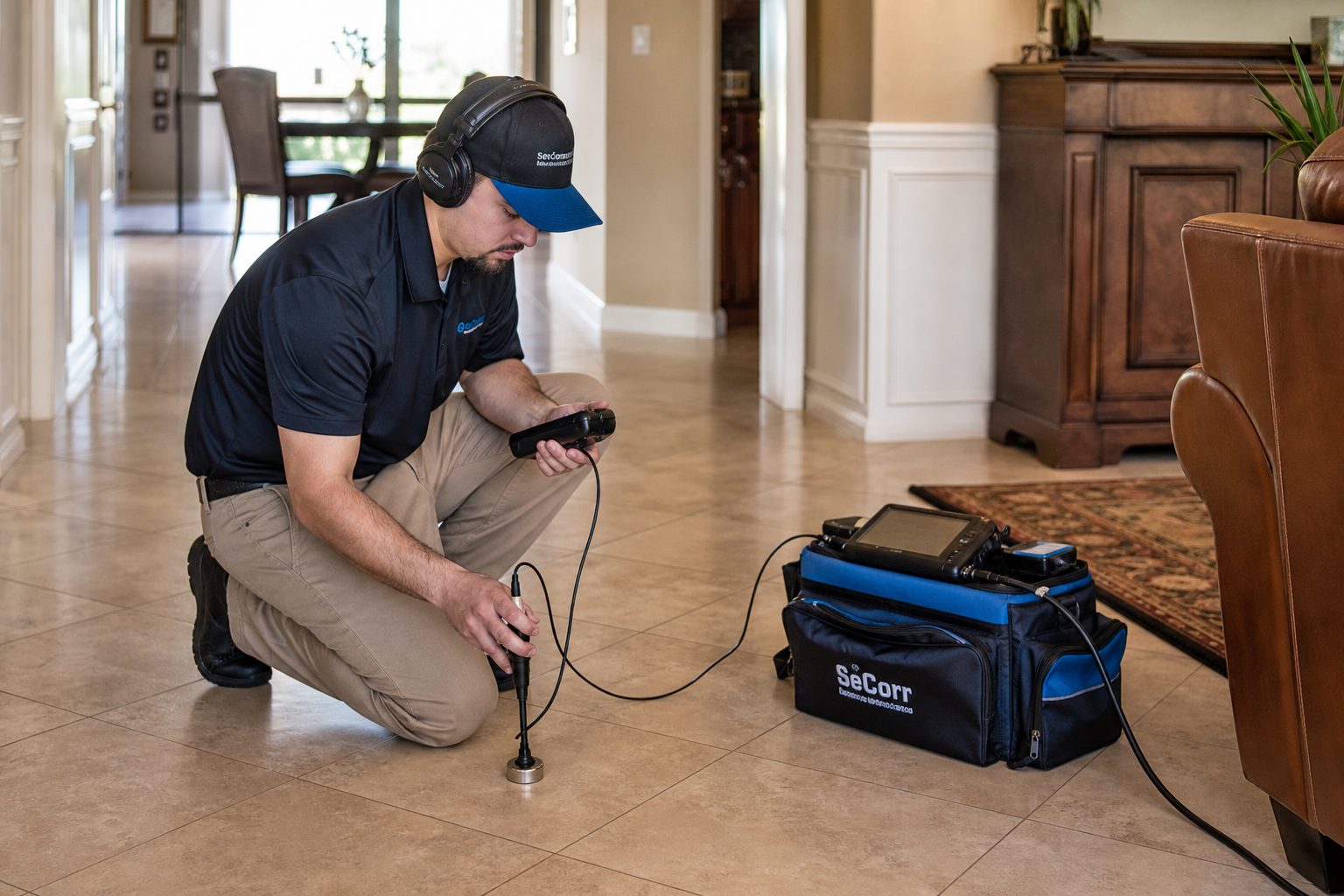
Ground microphones and amplified acoustic sensors pick up the signature of pressurized water escaping through concrete and soil. On a slab home we walk a methodical grid, marking wherever the signal peaks loudest.
On tougher cases we run inert tracer gas or line-tracing equipment to follow the pipe path and verify what the acoustic reading suggested. A second data point keeps us from marking the wrong tile.
A thermal camera exposes the heat signature a leak leaves behind in flooring and walls. A warm hot-water line under tile, or a cool moisture pocket behind drywall, shows up clearly and confirms the exact point.
Once we're confident, we mark the exact spot, photograph our readings, and put together a plain-language findings report. If a claim is coming, this gives your insurer the cause, the location, and the evidence up front.
With the source pinpointed, we lay out your repair options: a spot repair through a small access hole, a reroute that skips cutting the slab entirely, or a broader repipe if the system is aging out. You pick before anyone touches a tool.
Why one visit costs more than another
Every leak visit is a little different. Here's what genuinely changes the scope of the work, all discussed with you before we start.
- Depth of the leakAn exposed pipe under a cabinet reads quickly; a leak buried beneath finished flooring takes more equipment and more time to isolate.
- Square footage to coverA wide single-story slab home means more pipe run to grid-search than a smaller townhome or condo.
- What's on top of the pipeThick concrete, stacked flooring layers, and natural stone dampen sound signals and often call for extra confirmation methods.
- How many leaks are suspectedOlder galvanized or copper systems can develop several pinholes at once, and each one needs its own locate.
- Level of documentation neededA full insurance-grade report with imaging and readings takes more time to prepare than a quick verbal locate.
- Getting to the suspect areaFurniture, built-in cabinetry, and tight crawl clearances all affect how quickly we can reach and read a spot.
Rooted in Hollywood, reaching across three counties
Broward
- Hollywood
- Hallandale Beach
- Dania Beach
- Pembroke Pines
- Miramar
- Davie
Miami-Dade
- Miami
- Aventura
- North Miami Beach
- Doral
- Hialeah
Palm Beach
- Boca Raton
- Deerfield Beach
- Delray Beach
- Boynton Beach
- Lake Worth
Found it, marked it, fixed it
"Our water bill jumped and a plumber I called first wanted to tear up the whole kitchen floor. This crew brought listening equipment, found the exact spot near the pantry wall in about twenty minutes, and repaired it through one small cut."
A musty smell in the office had been bugging me for a month with no visible source anywhere. Their thermal camera picked up a cool spot behind the built-in shelving, right where a copper line had a tiny leak. Insurance approved the claim without any pushback thanks to the write-up they gave me.
"I'd already had one company tell me they'd need to open up three separate walls just to guess. These guys pressure-tested, listened, and marked the actual spot in one visit. Fair price, clean work, and they explained every step along the way."
"Warm patch showed up on our tile out of nowhere. Turned out to be a hot water line under the slab. They pinpointed it fast, laid out the repair options clearly, and never tried to upsell anything we didn't need."
Leak Detection Questions, Answered
Can you actually find a leak buried in the slab?
Slab leaks are common ground for us, since most homes in this part of Florida sit on slab-on-grade construction with water lines run directly through the concrete. We use ground-contact acoustic microphones to hear pressurized water escaping under the slab, then confirm with tracer methods and thermal imaging where needed. A hot-water leak often reads as a warm patch on the tile, which the thermal camera picks up right away. Once the location is confirmed from more than one angle, we mark it so any repair opening stays as small as possible.
Will you have to cut into my walls or floors first?
Avoiding unnecessary cutting is the whole point of what we do. Acoustic, electronic, and thermal detection all work through tile, drywall, and concrete without opening anything up. Most of the time we locate the leak with zero cuts and only open a small, precise access point once repair begins. That's a very different experience than the old approach of opening wall after wall and hoping to get lucky.
How close can you get to the exact spot?
On most pressurized supply leaks we can narrow the source down to a few inches. Accuracy improves when we can back up an acoustic reading with a second method, such as a thermal signature or a pressure drop test. Deep slabs, thick stone flooring, and multiple leaks at once make the search harder, which is why we work the area systematically instead of taking shortcuts. If a reading ever comes back unclear, we'll tell you directly rather than open the wrong spot.
Can I use your report for an insurance claim?
Yes. Every detection visit comes with a written findings report covering location, probable cause, and supporting evidence, including photos and thermal images where they apply. Adjusters generally want proof of exactly where the water escaped and confirmation the damage traces to a hidden or sudden failure. Having that documentation ready before repairs begin usually speeds up the claim considerably. Tell us about your claim ahead of time and we'll document with that in mind.
What determines the price of a detection visit?
Pricing depends on how deep the leak is hiding, the size and layout of your plumbing, what flooring we need to read through, and how many separate leaks need locating. A single exposed line is fast work; a slab leak under natural stone in a larger home takes more time and equipment. Adding a full insurance-grade report brings some extra documentation time as well. We look the situation over, walk you through what's driving the cost, and give you a firm number before starting anything.
Request A Detection Visit
Get an exact answer, not a demolition guess
Every day a hidden leak keeps running, it adds to your water bill and feeds mold behind the walls in South Florida's humidity. Let us pinpoint it non-invasively and put a documented, claim-ready answer in your hands. Lic. #XXXXXXX.