
"They put the camera down before quoting a dime. Turned out it was just one bad joint by the cleanout, not the whole yard like the first company told me. Saved me thousands and I have the video to prove they were right."
Sewer LineRepair
A backed-up main line has one real cause hiding somewhere in the run. a root ball, a dropped joint, a collapsed section, or old pipe rotting from the inside. We send a camera down first and let the footage tell us what's actually wrong, then price the fix around what we found, not a worst-case guess. Hollywood, Broward, Miami-Dade, and Palm Beach.

Six warning signs we get called out for
Every Drain Backs Up Together
When the shower gurgles the moment a toilet flushes down the hall, or two bathrooms rise at once, the trouble is past your traps and sitting somewhere in the shared main heading to the street.
A Root Mass Choking A Joint
Hollywood's older streets are lined with mature ficus, oak and banyan trees, and their roots chase every drop of moisture straight into a hairline crack. Onscreen a bad root intrusion looks like a tangled net snagging everything that flows past.
Pulled-Apart Joints
Sandy South Florida soil settles unevenly under slab homes, and over decades that movement pulls old clay or cast iron sections out of true alignment. Paper and waste catch at the lip of the gap until the whole line jams.
A Sagging Low Spot Holding Water
A section of pipe that's sunk below grade traps standing wastewater and sludge that never fully clears. On camera it looks like a pond sitting inside the line, and it's the reason the same clog keeps reappearing no matter how often you snake it.
Cast Iron Flaking From The Inside
Many Hollywood homes built before the mid-1970s still run original cast iron underground. Decades of humidity and mineral-heavy water eat away at the walls until scale narrows the channel down to a fraction of its original size.
A Rotten Smell Indoors Or A Wet Lawn
A sour sewage odor near a bathroom, or a soft, sunken patch of grass that never dries out, usually means wastewater is leaking below grade somewhere along the run and needs a camera on it right away.
The footage tells us whether to patch it or replace it
Most sewer lines don't need to come out end to end. If the recording shows one cracked joint or a single low spot in an otherwise solid run, we cut in at that point, swap the bad section, and camera the repair to confirm clean flow. If instead the video shows scale coating the pipe wall for thirty feet, three separate sagging sections, or a line that's separated in multiple places, a single patch will only buy you a few quiet weeks before the next backup. When that's the case, we tell you plainly and walk you through why a full replacement is the honest answer. Either way, you see the same footage we do before any decision gets made, and nothing gets sold on a guess.
From first look to backfilled yard
Push Camera Down The Cleanout
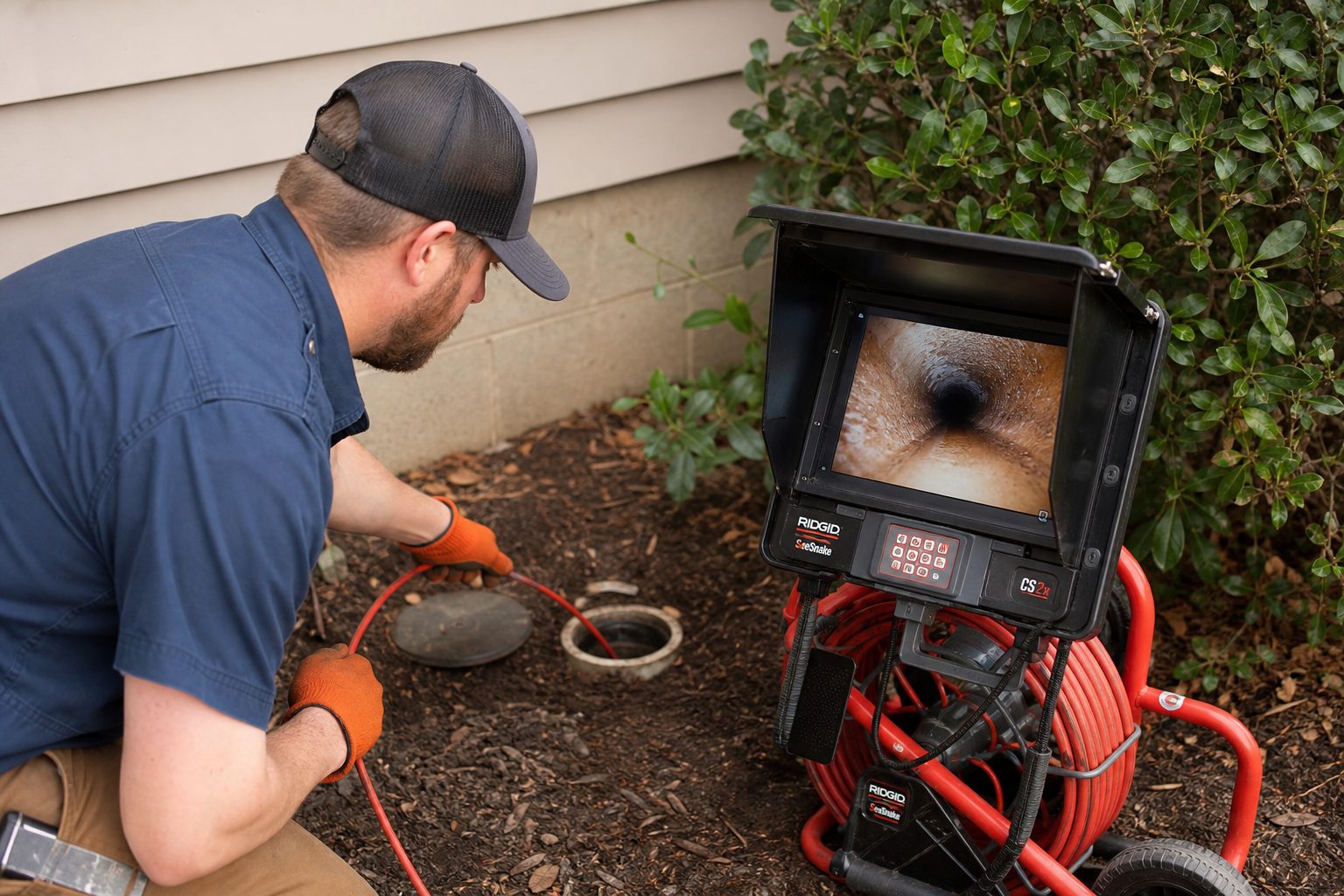
We feed a self-leveling camera through the cleanout and put the live feed on a screen you can watch beside us. A locator transmitter pinpoints the depth and yard position of whatever we find, so no one is digging on a hunch.
Name The Problem On Screen
Together we watch for roots, a shifted joint, a sag, flaking scale, or a full collapse, and gauge how much pipe is affected. That footage is what shapes the recommendation to patch a spot or replace the run.
Sign Off On A Written Scope
You get a firm number and a plain-language scope before any tool touches the ground. Where a permit is required, we file it under our license and coordinate the plumbing inspection so it's off your plate entirely.
Protect The Yard, Then Open It
Sod is cut and set aside in sections, soil gets stacked on tarps, and the dig footprint stays as tight as the located fault allows. Any trench is shored properly so we reach the pipe without turning the whole yard into a crater.
Cut, Rebuild, And Re-Slope
The compromised section comes out and gets rebuilt in new Schedule 40 PVC set to proper fall, joined with sealed couplings. We run the camera through the finished section again before a single shovel of soil goes back in.
Pass Inspection, Restore The Yard
We stand there for the county inspector, backfill in compacted layers, and reset the sod and soil close to how we found it. You keep a copy of the passed inspection plus a written guarantee on the section we repaired.
Why one sewer quote never matches another
Two neighbors on the same street can get two very different numbers, and it's rarely arbitrary. Here's what genuinely drives the price once the camera has shown us what we're dealing with.
- How deep and how far the fault runsA shallow crack near the cleanout is quick work; a fault buried under a driveway costs more to reach.
- Whether it's one spot or the whole runA localized cut-and-replace costs a fraction of relaying the entire line end to end.
- What's sitting on top of the lineOpen grass digs fast and cheap; a slab, pavers, or an established tree over the pipe adds real labor.
- The age and material of the existing pipeBrittle old cast iron or original clay tends to crumble further than the original fault once it's exposed.
- Permit and inspection requirementsHollywood, Broward, and Miami-Dade jurisdictions each have their own scope thresholds for when a permit applies.
- How much needs restoring afterwardRe-sodding a small patch is easy; rebuilding a driveway section or patio slab adds to the final bill.
Rooted in Hollywood, running across three counties
Hollywood & Broward
- Hollywood Beach & Downtown
- Emerald Hills
- Hollywood Hills
- Boulevard Heights & Driftwood
- Pembroke Pines
- Miramar & Davie
Miami-Dade
- Miami
- Aventura
- Hallandale Beach
- North Miami
- Sunny Isles Beach
- Miami Beach
Palm Beach
- Boca Raton
- Delray Beach
- Boynton Beach
- Deerfield Beach
- Lake Worth Beach
- West Palm Beach
Real jobs, real footage, real feedback
"Old cast iron under my house was basically gone. They pulled the Broward permit themselves, met the inspector on site, and I never had to make a single call to the county. Line runs like new now."
"What stood out was how neat the dig was. Sod went back down so well I could barely tell they'd been in my yard for two days. They also camera'd the finished line right in front of me before covering it up."
"We'd snaked the same clog three times in a year before calling. Camera showed a dip in the line holding water every time. They replaced that one section and it's been six months without a single backup."
Sewer Line Repair, Answered Straight
What exactly does the camera let you see?
The camera travels from your cleanout all the way toward the city connection, giving us a live picture of the pipe's interior condition. We can spot a root mass feeding through a crack, a section that has dipped below its proper slope, scale narrowing old cast iron, or a joint that's separated entirely. A locator transmitter also marks the exact depth and yard position of anything we find, so digging targets the actual problem instead of an estimate. You watch the same feed we do, and we keep a copy so the diagnosis is documented, not just described to you.
Once you remove the roots, will they just come back?
Roots only return if there's still a crack or open joint for them to reach through. That's why cutting the root mass out and calling it done rarely lasts. We remove the compromised section and rebuild it in solid, sealed PVC so there's no gap left to invite them back. Hollywood's mature tree canopy means the pressure never really stops, so if a nearby tree sits right over the pipe we'll point that out too. Closing off the entry point is what actually keeps the line clear, and that repaired section carries our written guarantee.
Who deals with the permit and the county inspection?
We do. Sewer work that opens the ground or replaces a section typically needs a plumbing permit, and the exact threshold varies between Hollywood, unincorporated Broward, and neighboring Miami-Dade municipalities. We file the paperwork under our license, schedule the inspection window, and stand there when the inspector shows up so it gets signed off correctly the first time. You get a copy of the passed inspection for your own records. Handling this ourselves keeps the repair legitimate and protects you if the home ever sells.
How long does a typical sewer repair take?
A single-spot repair on a shallow line near the cleanout is frequently finished in a single day, from digging in to camera-verifying the fix and closing the trench. A full replacement of a long run, or any repair under a slab, driveway, or established landscaping, can stretch across two or more days depending on depth and how much restoration follows. Permit review timing in some municipalities can add a scheduling step too. We give you a realistic window for your specific line once we've actually seen it, not a generic estimate.
How do you decide between a spot repair and a full replacement?
The recording makes that call for us, not a sales quota. If the pipe is generally sound apart from one cracked joint or a single dipped section, a spot repair is the honest and cheaper fix, and we'll recommend exactly that. If the footage instead shows scale coating a long stretch, multiple low spots, or old cast iron failing in several places, patching one point only delays the next backup by a few weeks. In that case we say so plainly and explain why a full replacement is the better long-term move. You always see the marked-up footage before deciding either way.
Schedule Your Camera Inspection
Get an answer, not a guess
Let a camera tell you what's actually happening under your yard, get a straight spot-versus-full recommendation, and hand the permit, the dig, the yard, and the inspection to a crew that stands behind the work. We're based right here in Hollywood and cover Broward, Miami-Dade, and Palm Beach, every repair backed by a written guarantee on the section we fix.
Call (954) 613-1060