
Homeowner Guide
Is Water Leaking Somewhere You Can't See? 7 Clues to Check Today
Most damaging leaks never show up as a puddle. They show up as a strange smell, a soft spot in drywall, or a bill that doesn't match your habits. Here's how our team walks Hollywood homeowners through spotting them early, before a small drip turns into a rebuild.
Why the quiet leaks are the dangerous ones
When people imagine a plumbing leak, they picture a faucet that won't stop dripping or a puddle collecting under the kitchen sink, something obvious that gets fixed the same day. The leaks that actually cause five-figure repair bills are different. They start behind a wall, inside a slab, or underneath a cabinet, and they keep running for weeks while everything on the surface looks fine.
Homes in and around Hollywood are typically built on poured concrete slabs, which means the supply lines feeding your fixtures often run beneath the floor itself. Once one of those lines develops a failure, water doesn't pool where you'd notice it. It travels through soil and slab and finds the path of least resistance, sometimes surfacing rooms away from the actual source. Add in decades-old copper piping that's had time to corrode from the inside, and hidden leaks become a genuine risk for older properties across Broward County.
We put together the seven signs our technicians hear about most from customers after the fact, the moments they wish they'd acted on sooner. Notice even one of these, and it's worth having a professional take a closer look.
1. Your bill climbed and nothing changed
Nobody moved in, nobody's filling a pool, the sprinklers are on the same schedule, yet the water bill is noticeably higher than last month. That gap usually means water is being used somewhere you can't account for. A leak doesn't take breaks, it runs continuously, so even a modest, invisible drip can add up to a large number by the time the statement arrives.
Pull up your last three bills and look for a pattern rather than a one-time blip. Consistent upward drift is the signal worth chasing down.
2. The meter keeps spinning with everything shut off
This is the simplest test you can run yourself. Turn off every fixture and appliance in the house, then go find the water meter, often at the curb or near the property line, and watch the small dial or leak indicator. If it's still moving with nothing turned on inside, water is escaping into your system somewhere between the meter and your fixtures.
Quick test: Write down the meter reading, wait 60 minutes without using any water, then check it again. Any movement confirms an active leak. Our leak detection crew can then narrow it down to an exact location.
3. A patch of floor that's warmer than the rest
Walk across your tile in bare feet. A spot that feels noticeably warmer than the surrounding area can mean hot water is escaping from a line buried in the slab and heating the concrete above it. It's one of the more reliable physical cues of a slab leak, and it's confirmable with thermal imaging in minutes.
Why you shouldn't try to open the floor yourself
The pipe causing the problem is sealed inside concrete, so guessing where to break through usually means unnecessary demolition. A proper scan narrows the repair to a small, targeted opening instead of a torn-up room.
4. Musty smells or spreading discoloration
Trapped moisture behind walls or under flooring is exactly the environment mold needs. A closet, bathroom, or laundry room that smells persistently musty, or dark spots that keep reappearing on a ceiling or baseboard after cleaning, points to a moisture source that's still active. Florida's humidity accelerates this process, so don't wait to investigate.
If the stain returns within days of being wiped down, treat it as an ongoing leak rather than old residue.
5. Water pressure that's noticeably weaker
A leak upstream of a fixture steals pressure before the water ever reaches your shower or faucet. If pressure has dropped gradually across the house, not just at one aerator that might simply need cleaning, a supply-line leak could be the reason water isn't making it to you at full force.
6. A hissing or trickling sound with everything off
Stand quietly somewhere in the house and listen. A faint hiss or the sound of running water coming from inside a wall or beneath the floor, when no fixture is in use, usually means water is moving where it shouldn't be. Acoustic equipment can amplify that sound and help our technicians triangulate the source.
7. Baseboards or walls that feel damp or look warped
Moisture wicking up from a slab or through drywall softens whatever it touches. Watch for baseboards that have started to bow, paint that's bubbling, or hairline cracks forming near the base of a wall. Drywall that feels cool and spongy to the touch is a strong sign there's active water nearby, not just old damage.
How we track down a leak without demolishing your home
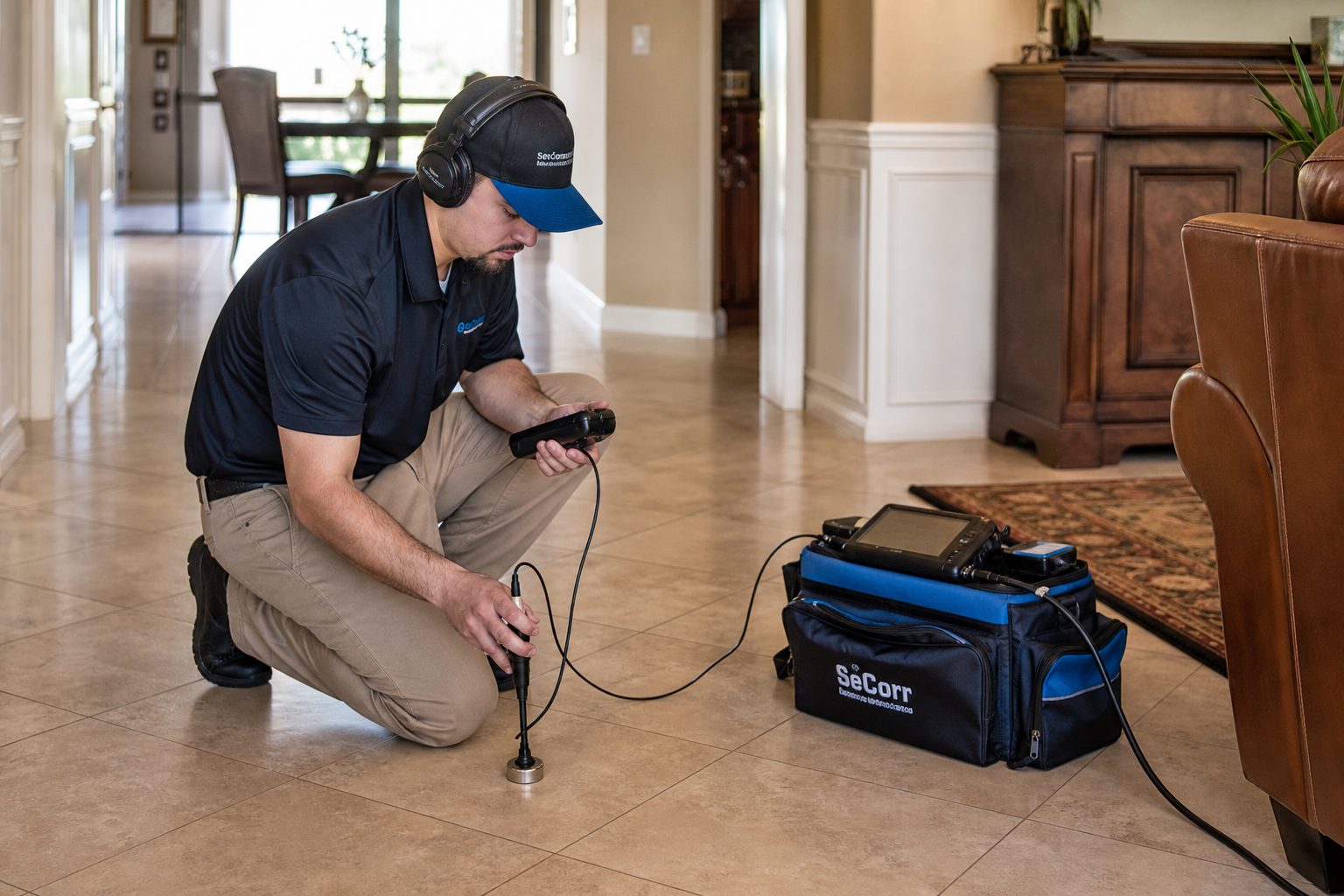
The reason so many homeowners put off calling is a fear of jackhammers and torn-up floors. That's not how modern leak detection works. We rely on two tools that let us find the source without guesswork:
- Acoustic listeningSensitive microphones pick up the sound of pressurized water escaping a pipe, even through several inches of concrete.
- Infrared imagingThermal cameras highlight temperature shifts caused by escaping hot water or spreading moisture, mapping the leak's shape before we cut anything.
Combined, these methods let us mark a small, precise access point instead of opening an entire room. It's quicker, less disruptive, and considerably cheaper than exploratory demolition. More detail on our process is on the leak detection page.
Repeat leaks usually mean it's time to talk repiping
If this isn't your first pinhole leak in the last year or two, that's a pattern, not coincidence. Corrosion that caused one failure is likely present throughout the same run of copper pipe. At that point, patching leak after leak becomes more expensive than addressing the whole system, and full home repiping is often the better long-term investment. We'll walk you through both options honestly.
One thing that mimics a hidden leak on your water bill: a toilet that runs silently. Before assuming the worst, check our guide on diagnosing a toilet leak to rule that out first.
Not sure what you're dealing with? Call (954) 613-1060 and we'll get a technician out to find it.
More from our library
Practical plumbing guidance for Hollywood-area homeowners.
Hub / Blog
All Our Plumbing Guides
Browse every article we've written on maintenance, repairs, and what to watch for at home.
Read moreRelated Read
Diagnosing a Running or Leaking Toilet
A toilet that leaks quietly can waste more water than you'd expect. Here's how to check it yourself.
Read moreOur Service
Leak Detection Without the Demolition
Acoustic and thermal tools that locate the exact source before we ever open a wall or floor.
Learn moreOur Service
Whole-Home Repiping Options
When one pinhole leak turns into several, replacing the aging line ends the cycle for good.
Learn moreCatch it before it spreads
Suspect a hidden leak in your Hollywood home?
(954) 613-1060Licensed & Insured. Lic. #XXXXXXX